






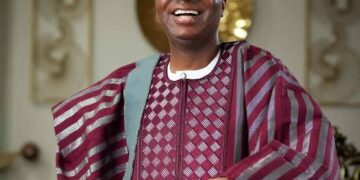


I became close to Col. Peter Obasa in 2018, when I had my first Life Lessons conversation with him. For some reason, our relationship grew beyond the interview. He has remained one of the most cerebral elders on the THISDAY Life Lessons platform, and one of those people with whom a conversation can easily move from an ordinary subject to the deepest questions about life, faith, leadership and the human mind.
Not long ago, he called me with a question.
He wanted to know where Tim Akano—“Headmaster”, as we affectionately call him on the platform—gets some of the strange and fascinating concepts he regularly throws at us.
I laughed.
I told the elder that if I had not known Tim since our university days at Ife in 1983, I probably would have been tempted to ask him exactly the same question.
My answer was simple: Tim is a compulsive reader and researcher.
That, in fact, was how Tim and I became friends.
As students at the University of Ife, we would sometimes gather around the newspaper stands on campus and spend money meant for food on newspapers instead. We were completely fascinated by the ideas we encountered in their pages.
We read the writings of some of the finest minds of that generation: Tai Solarin, Dr Yemi Ogunbiyi, Edwin Madunagu, Dele Giwa, Dele Olojede, Dare Babarinsa, Dr Tunji Dare, Chief Segun Osoba and many others.
Sometimes, we missed classes because we were so absorbed in what these men were saying.
And the funny thing was that we were happy missing the classes.
We were receiving another kind of education.
Years later, I visited Tim’s library and discovered that he had preserved much of that intellectual journey. He still keeps old copies of newspapers and magazines such as Tribune, The Guardian and Newswatch.
Not long ago, he gathered more than 100 books from his personal library and donated them to his department of International Relations at Obafemi Awolowo University.
I asked him why he was giving away some of his treasured books. His answer made me laugh.
He said he needed to give away some of his books because he was trying to “win himself a little” from his addiction to books.
That is Tim.
But my conversation with Col. Obasa got me thinking about something else.
There are certain people whose minds appear to become even more active when the world goes quiet.
And Col. Obasa is one of them.
THE MAN WHO OWNS THE MIDNIGHT HOURS
For years, one thing has been remarkably consistent about my relationship with Col. Obasa: our most interesting conversations happen between midnight and about 3 a.m.
That is when the elder is awake. Not occasionally, but regularly.
He has maintained this unusual rhythm for decades. Now in his late eighties, he has not abandoned the habit. If anything, it seems to have become part of the architecture of his life.
So one day, I asked him:
“Elder, where did this habit come from?”
His answer took me back to one of the darkest chapters of his life.
Prison.
Col. Obasa spent seven years and 56 days in prison. His distinguished military career had appeared to be heading towards a glorious conclusion before his life took a dramatic turn. In his 2019 Life Lessons interview, he described the experience as a complete reversal of fortune—from the height of his career to a prison cell.
But something extraordinary happened to him in that place.
Prison became a school of the spirit.
He told me that prison created an unusual opportunity for concentrated spiritual development.
While at Ikoyi Prison, one of his prison mates, Mr Olu, suggested that they begin midnight prayers. They started around May 1984.
Col. Obasa became the timekeeper, waking the others when it was time to pray.
Eventually, circumstances separated the group. But the practice did not leave him.
From September 1985, while in Sokoto, he continued the midnight vigil on his own.
What had begun as a group discipline in prison had become a personal spiritual discipline. And he has apparently never stopped.
In his own account, prayer—particularly prayer combined with fasting—became a powerful discipline for him.
There is something even more profound about this.
Obasa did not emerge from prison merely bitter about what had happened to him. He emerged spiritually transformed.
In an earlier Life Lessons conversation, he told me that he had learnt to reserve absolute trust in God. When he was arrested, he had no idea where the journey would lead. He had carried only a small New Testament Bible with him.
Then, after asking God for direction, he opened the Bible and encountered Hebrews 13:5–6, which speaks of God’s assurance never to leave or forsake His people.
He said the message gave him peace and confidence. He has carried it with him ever since: “The Lord is my helper.”
Perhaps that explains something about the man I have come to know.
For Obasa, the night is not simply a period when other people are sleeping.
It is a meeting place.
A meeting place with God. A place for prayer. A place for reflection and, increasingly, a place for writing.
THE MIDNIGHT JOURNAL
There is another part of this habit that fascinates me.
During his midnight vigil, the elder journals. Every single day.
He writes.
That habit, he tells me, has helped keep his mind stimulated and active.
Perhaps this is one reason conversations with him remain so intellectually engaging. He has spent decades deliberately exercising both sides of his inner life: the spiritual and the intellectual.
He prays.
He thinks.
He writes.
He reflects.
Then he does it again.
It reminds me of something else he told me about his prison experience.
He once described prison as a place where his physical freedom was taken away, but where he discovered another kind of freedom—the freedom that comes from within when a person learns to see God even in confinement.
The warders eventually called him “Sarkin Hankuri”—the “King of Patience”—because of his unusual composure.
That may be one of the deepest lessons in his story.
A man can be physically confined and yet intellectually and spiritually free.
Perhaps the midnight hours became one of the places where that freedom was exercised.
THE THREE MEN
This is where my curiosity has taken me.
I have begun thinking about three remarkable Nigerian men:
Col. Peter Obasa.
Bishop David Oyedepo.
Chief Nduka Obaigbena.
They come from very different worlds: a military officer and former Director-General of the National Youth Service Corps; a globally influential Christian leader; and a media entrepreneur and publisher.
Yet there appears to be an intriguing common denominator in their lives.
They do not surrender the night easily.
While many people regard midnight as the end of the day, these men seem to regard it as the beginning of another kind of day.
For Obasa, the night became a sanctuary for prayer, reflection and journaling.
For Oyedepo, the night has long been associated with spiritual engagement, study, planning and the pursuit of revelation.
For Obaigbena, the night has been part of the demanding rhythm of a media entrepreneur whose working life has often stretched far beyond conventional office hours.
Their reasons may differ, and their experiences are not necessarily identical. But their stories invite a common question.
What happens when people deliberately use the hours that others surrender to sleep?
The question, therefore, becomes bigger than “Why are these men awake at night?”
The more interesting question is:
“What are they doing with the hours when everybody else is asleep?”
Because perhaps the secret is not in staying awake.
Perhaps the secret is what you do with the extra hours.
And that is the conversation I want to have.