







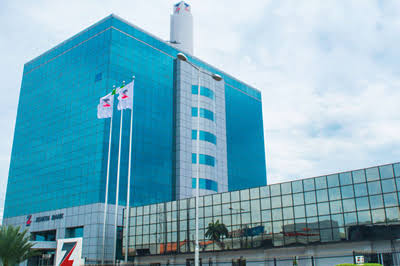
Zenith Bank Plc recorded a N101.4 billion, or 19%, decline in after-tax profit for its half-year operations, despite a significant reduction in bad-loan losses.
Balancing costs and income to keep profit up is not working out this year for the multinational banking group, and the biggest profit drop in years looks quite likely for the N33 trillion financial institution.
The bank’s audited half-year financial report for the period ended June 2026 reveals that the loss of one critical income line is the challenge facing the bank this year. Net trading gains, which contributed about N468 billion, or 18.6%, to gross earnings in the same period last year, reversed into net trading losses of more than N92 billion at the half-year mark.
The loss of this income line caused a sudden drop of N621 billion, or 24.6%, in gross earnings year over year, to roughly N1.90 trillion at the end of June 2026.
Asset trading losses are rising for the bank for the second year, following a deep plunge from the peak of N1.10 trillion in gains in 2024 to losses exceeding N63 billion in 2025. The loss figure for the full year 2025 has already been exceeded in the first half of this year.
The bank is on the downward side of a revenue cliff that had been powered by massive trading gains totaling more than N2 trillion in the two years through 2024.
The sharp drop in the naira’s exchange rate had enabled banks to rake in substantial trading gains in 2023 and 2024, while the local currency’s gradual appreciation has been reversing those gains since last year.
Cost-cutting has been Zenith Bank’s strategy since last year to prevent profit from crashing amid revenue constraints. Gross earnings rose only marginally to N4.19 trillion at the end of last year, while after-tax profit inched up to N1.04 trillion.
Stringent cost management made that possible, and the cost of funds bore the brunt of the cuts, with its increase slowing sharply to 4%, while customer deposits grew more than two and a half times faster, at 10.8%, to N24.32 trillion.
This year, the focus of cost-cutting has shifted to loan impairment expenses, as reductions in interest expenses are not providing sufficient savings. While the cost of funds declined faster than interest earnings, by about 13% compared with about 9% year over year, the savings could not prevent a 7.4% drop in net interest income to N1.25 trillion at the half-year mark.
The bank’s management then cut net loan impairment expenses to N141 billion at the half-year mark, less than one-fifth of the N762 billion charged in the same period in 2025.
This move changed the picture from a decline in net interest income to an almost 88% leap in net income after loan impairment charges, amounting to N1.11 trillion.
The savings, however, failed to reach the bottom line, as trading losses and increases in operating expenses virtually consumed them. The operating cost margin jumped from 23% to 33.4% over the period.
The measures did, however, keep profit from falling as rapidly as revenue. While gross earnings dropped by almost a quarter, pretax profit closed slightly higher year over year, at about N638 billion.
Income tax expenses grew by more than 121% to almost N207 billion, claiming 32.4% of pretax profit and resulting in a drop in after-tax profit from more than N532 billion to N430.8 billion at the end of the half-year period.
How sustainable the reduction in bad loan losses will be remains to be seen, as credit expansion continues. Net loans and advances to customers increased by N1.60 trillion in the first six months of the year, up from a moderate increase of N485 billion over the entire 2025 financial year.
Unlike in the preceding financial year, when cost savings managed to cover revenue shortfalls and cost increases, trading losses and higher income tax expenses are preventing the bank from maintaining its bottom line so far this year.
Whether the profit drop will continue through the full year is a key development to watch at Zenith Bank in the second half. Trading losses can be expected to persist as long as the naira continues its gradual appreciation. All the trading losses incurred last year occurred in the second half.
Credit expansion is expected to continue as management aggressively pushes interest earnings to offset trading losses. But keeping loan losses down amid increasing credit volumes looks like a tall order.
Further cuts in interest expenses to generate additional savings may be introduced in the second half as management reinforces its cut-and-patch approach to striking a balance between costs and income.
Zenith Bank closed the half-year period with earnings per share of N10.48, down from N12.95 in the same period in 2025. The directors have announced an interim cash dividend of N1.50 per share.
The dividend qualification date is 23 October, and payment is scheduled for 30 October 2026.