







Imagine you own a small supermarket. At the end of the day, you ask your salesperson, “How much did we sell today?”
He replies confidently, “Sir, business was very good!”
Wonderful! But “business was very good” is not an accounting figure.
You ask again, “How much exactly?”
He scratches his head. “Maybe around ₦350,000… or ₦400,000.”
You check the bank account and find ₦210,000. There is another ₦45,000 in cash in the drawer, and some customers bought goods on credit.
Now everybody is doing mathematics!
This is why every business, no matter how small, needs a proper sales record.
A business may be busy, attract many customers and sell goods every day, yet struggle to account for its money. Without reliable records, the owner may not know exactly how much was sold, how much was collected, how much customers still owe or whether some money is missing.
The solution is simple: record every sale.
What Is a Sales Record?
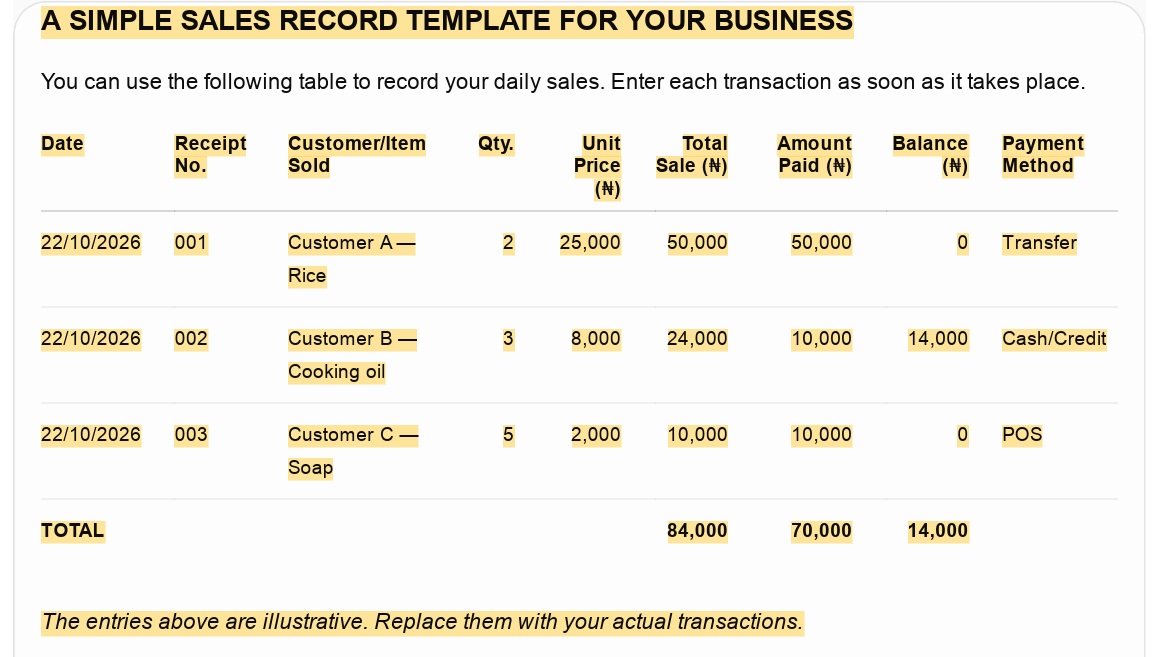
A Sales Record is a document or register that captures the details of goods sold or services rendered by a business. It shows what was sold, when it was sold, the quantity, the selling price, the amount due and the payment received.
Where necessary, it should also identify the customer and the invoice or receipt issued. For credit sales, it should show the outstanding balance.
A simple Sales Record can contain the following information:
- Date of sale
- Customer’s name, where applicable
- Invoice or receipt number
- Item sold or service provided
- Quantity sold
- Unit price
- Total sales value
- Amount paid
- Amount owed
- Payment method, such as cash, bank transfer or POS
A very small business that handles mostly cash sales can use a simpler format. The important thing is consistency and completeness.
Every sale should leave a footprint!
Why Should You Keep a Sales Record?
1. It Tells You How Much You Are Really Selling
Without proper records, a business owner may confidently declare, “Sales are improving.” But improving from what to what?
Your Sales Record can tell you that yesterday’s sales were ₦85,000, today’s sales were ₦110,000, this month’s sales have reached ₦2.4 million, and last month’s sales stood at ₦1.9 million.
Now you are managing your business with facts rather than feelings.
Accurate sales figures help you monitor performance, compare periods and identify trends. They also enable you to set realistic targets and determine whether your business is moving in the right direction.
2. It Helps You Identify Your Best-Selling Products
Suppose you sell shoes. Your records show that black office shoes sell quickly, while a particular yellow shoe has remained on the shelf for eight months.
Even the shoe itself may now be wondering: “What exactly did I do wrong?”
Your Sales Record can reveal what customers actually buy. With this information, you can stock more of the products that sell well and reduce purchases of those that remain unsold.
This helps you make better purchasing decisions, reduce the risk of tying up money in slow-moving goods and improve inventory management.
Without sales data, you may keep buying products simply because you like them rather than because customers want them.
3. It Helps You Control Cash and Detect Missing Money
Suppose your records show that your business made sales worth ₦300,000 today. Customers paid ₦200,000 through bank transfers, ₦70,000 through POS and ₦30,000 in cash.
The figures add up:
₦200,000 + ₦70,000 + ₦30,000 = ₦300,000.
But what happens if you count the cash in the drawer and find only ₦20,000 instead of ₦30,000?
There is a ₦10,000 discrepancy that needs to be investigated.
A Sales Record helps you compare sales with payments received and identify unexplained differences. It can also discourage theft, unauthorised discounts and other irregularities.
However, recording sales is only part of the process. The business owner must also reconcile the records with actual cash, bank transactions and POS settlements.
4. It Separates Cash Sales from Credit Sales
Not every sale means money has entered your pocket.
Suppose you sell goods worth ₦500,000, but customers pay only ₦300,000 immediately and promise to pay the remaining ₦200,000 later.
Your sales total ₦500,000, but you have received only ₦300,000.
The outstanding ₦200,000 should be recorded in your Debtors Record so that you can follow up on payment.
Otherwise, you may be celebrating impressive sales figures while your customers are enjoying what amounts to free loans!
This distinction is particularly important for small businesses because sales and cash flow are not the same thing. A business can record substantial sales and still lack the cash needed to pay suppliers, workers or rent.
5. It Helps You Measure Business Performance
A good Sales Record can answer important questions about your business:
- Which products or services generate the most sales?
- Which days of the week are busiest?
- Which customers buy most frequently?
- Are sales increasing or decreasing?
- How much of your sales are paid for immediately?
- How much remains outstanding?
- Which products are selling too slowly?
The answers can guide decisions about pricing, stock levels, promotions, customer service and business expansion.
For example, if your records consistently show higher sales on weekends, you may need to adjust staffing and stock levels to meet demand. If sales of a particular product are declining, you can investigate whether the cause is price, competition, changing customer preferences or poor product visibility.
In this way, record keeping becomes more than an accounting exercise. It becomes a tool for managing and growing the business.
6. It Makes Your Other Business Records Work Together
This is where the real value of proper record keeping becomes clear.
When you make a sale, several records may be affected, but each serves a different purpose.
The Sales Record shows what was sold and the value of the transaction.
The Cashbook records money received and paid out.
The Debtors Record tracks amounts customers owe the business.
The Stock or Inventory Record tracks the goods that have left the business.
These records complement one another. Together, they help the owner understand what happened during a transaction, what money was received, what remains outstanding and how the sale affected inventory.
For example, if you sell goods worth ₦100,000 and the customer pays immediately, the sale should appear in your Sales Record, the payment should be reflected in your Cashbook, and the stock record should be updated to reflect the goods sold.
If the customer buys on credit, the outstanding amount should also be entered in the Debtors Record.
The aim is to ensure that no important part of the transaction is overlooked.
Keep It Simple
Your Sales Record does not need to be complicated. Do not design a system so difficult that you need another course before you can use it!
Start with a simple table containing the date, customer, item sold, quantity, total sale, amount paid, balance owed and payment method.
You can maintain the record in a notebook, a spreadsheet or suitable accounting software. What matters most is that every sale is recorded promptly and accurately.
For businesses with many transactions, sequential invoice or receipt numbers can make it easier to trace individual sales and identify missing records.
At the end of each day, review the entries and reconcile the amounts recorded against payments received through cash, bank transfers and POS. Investigate any unexplained differences instead of allowing them to accumulate.
Remember: sales without records can make a busy business look successful while money quietly disappears through the back door.
Your business should not merely be selling. It should know what it is selling, how much it is selling, who owes it money and where the money has gone.
If you sold it, record it!
The Sales Record is one of the six essential business records in the simplified EASY business-record-keeping system we have been developing.
We have discussed the Cashbook, Sales Record, Debtors Record and Creditors Record. The remaining records are the Purchases and Expenses Records, and the Stock or Inventory Record.
Together, these records provide a practical foundation for small-business owners who want to understand their finances, control their operations and make informed decisions.